History Mehmet Uyav of Güllük Building process Gulet Types
In 1923 at the end of the Ottoman Empire, the Republic of Turkey was born under the extensive reforms of Ataturk. Bodrums local populace, concentrated inland along the western harbour, had been making a marginal living from picking cotton and tobacco, tending tangerine groves, olive and fig trees and from animal husbandry. However, with the new arrivals, agriculture, fishing, sponge diving and boat-building were enriched with new persons and ideas, and a glimmer of economic revival began to flicker.
Later after WORLD WAR II the small boat-building industry re-emerged, constructing the caiques, tirhandils and ayna kiçs.
In the 1960, the first references to building gulets are found. During these years the larger boatyards were located on the western tip of the harbour, currently the site of the Seçkin Konaklar Hotel. This is
only a few meters from the location of the Ottoman boatyards which built galleons of the 19th century. There were also a couple of boatyards on the west side of the eastern harbour, just below the
Castle of St. Peter .
Ziya Güvendiren was the recognized master boat builder of Bodrum during the 1940s and 50s. Many future builders were trained under him as apprentices, including Mehmet Özyürt and Erol Agan, both still actively building in Bodrum today.
Erol Agan, who was working for Ziya Güvendiren at his boatyard east of the castle, told :
"Ziya's original boatyard used to be by the [Cafer Pasa's] tomb [currently within the new yacht marina]. There he built small rowboats under ten meters. Once we moved to the boatyard east of the castle, Ziya Usta began to build 18-20 meter tirhandils and gulets. At first only foreigners were ordering them...we built them without any plans but with our eyes...build the bow and the stern and shape it accordingly!
Naminin Mehmet Uyav was Ziya's teacher, but Ziya was also largely a self-taught man. I remember Naminin Mehmet building tirhandils on the Kumbahce beach.
After my military service, I lost my arm in an accident but continued to work, opening my own boatyard next to Ziya's behind the castle. I was there for 15-20 years until moving to Içmeler to the boatyard I have today. We didn't have water or electric, and the land was covered with rocks. It took ten years to develop it into a well functioning boatyard with lifting facilities."
Today, most of Bodrum's boatyards are located in Içmeler, but there are also well-known boatyards in Gümbet, Ortakent, Yalikavak, Tavsanburnu and Güllük. A boatyard in Bodrum, is often literally a boat in a yard. There are numerous families who partake upon the construction of a boat with their own initiative just below the kitchen window. A stroll through the back streets of Bodrum will reveal some of these delightful home projects.
At the end of 1998, there were approximately 4500 boats offıcıally registered in Bodrum. Most of them were built in Bodrum in one of over a dozen large boatyards and numerous small ones.
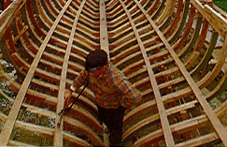
The procedure of building boats today has changed very little over the centuries. The changes to the basic plank-on-frame method are superficial: electrical tools now allow craftsman to sand and shape wood faster and with more precision than they used to be able to by hand, and laminated epoxy allows for increased design options. Inside the boat, design changes over the years
have increasingly opted for larger dining facilities, well-designed cabin layout, including air conditioning, and even on-board jacuzzis.
A Saturday Afternoon with Mehmet Uyav of Güllük
My interview with Mehmet Uyav was remarkable in several respects. The sincerely warm greeting that was bestowed upon me when I showed up on his doorstep with absolutely no
warning, no identification, no intermediate contacts, but only with a request to meet him, was genuine. But even more important were his extremely carefully chosen words, often followed by a hesitation, reaching for an earmarked
page of a yellowing manual or a chapter in his vast collection of books to find a picture, or an excerpt or quotation, or to illustrate a precise thought for his unexpected guest. I asked him to tell me about his family, now in its
fourth generation of building boats in Turkey:
In 1924, Nami Uyav Kaptan sailed his 250 ton galleon from Crete into Bodrum harbour to start a new life. He engaged in sea trade until the galleon was sunk as it was docked just behind the Bodrum castle during the French bombing
of World War II. Following the loss of his ship, Nami Kaptan moved about 40 kilometers north of Bodrum to Güllük and engaged in small scale fishing until his death at age 85.
His son, Naminin Mehmet Usta, moved back to Bodrum and began building boats from watching Greek carpenters working with drawings and plans, something very new to local boat builders. He built his first boat ( a 7 meter ayna kiç
cargo vessel ) in the 1950s. The Bodrum Harbour Master was quite taken with the boat and named it himself: Semeri Sebat, which translated means "Of his own making", referring to Naminin Mehmet Usta's unique approach to
building the boat. Cevat Sakir was a friend, often stopping by to watch the boat's completion, and it was during these years that Ziya Güvendiren, Bodrum's best known gulet master, began to practice and master his own craft. With family
connections still remaining in the trading port of Güllük, Naminin Mehmet Usta returned there and began building wooden racing boats, tirhandils and sponge diving boats. The average length of boats being built was 14 meters. He
also made small passenger ferries for the Menderes River, since road transport was still cumbersome in the 1950s. "Ege Güllü" was his last boat before retiring.
His son, Ali Uyav was by profession a civil servant assigned to fixing lighthouses but continued with the family tradition of boat-building, especially speedboats. Ali Uyav's son, Mehmet, attended the Nazili Sanat Institute and in 1976 formed the "Dedesan" Company, firmly cementing the family tradition of boat-building in its fourth generation. Mehmet Usta's interest in sailing and hull design led him to the practice of first building miniature wooden models from the ship's actual plans. "I build a miniature wooden model of the boat, and inspect her closely. I toss her into the water and see how she sits. I create some waves and watch how she rolls. I make adjustments if needed, and another model until I am satisfied. Then I proceed with building the boat."
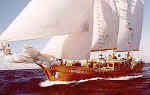
Mehmet Usta has continued at the helm of his company for over 25 years now, and has built dozens of boats, many of which have been exported abroad, and has been featured in numerous publications; one of the know boats is the Kybele build in 1990 and still participating in sailing races.
The Building Process
T
When the hull is almost completed a customary ceremony takes place: the insertion of the baklava wood. The baklava wood is the last piece to be inserted It is called baklava wood because its insertion signifies that an important
phase of construction is now finished, and a joyful event accompanied by a small celebration featuring baklava ensues. After this minor milestone, work then continues on interior and topside
construction.
Many of Bodrum's native boat builders learned their skill as apprentices to the late Ziya Güvendiren,
Bodrum's master boat builder who lived and worked here all of his life. Today's boat builders pass on those same skills to their young apprentices who may one day start yards of their own.
When boats were built for purposes other than pleasure, one man or team did all the woodwork. Now, as quality and appearance become more important in the construction of luxury yachts, specialization frequently occurs, demanding
fine interior and exterior craftsmen. For some yachts special cabinet makers have been employed to ensure joinery of the highest standards.
In addition to all woodwork, all metalwork is also done in the yard or by special fitters in Bodrum, usually in stainless steel. Raw pieces are shaped to fit the required applications, be it spar, stern rail or fuel tank.
Rigging is constructed by the yard or local specialists, custom designed and fitted to each yacht individually. With the exception of mechanical parts such as engines or electronics which are bought elsewhere, the entire craft is supplied and constructed by local craftsmen in Bodrum.
Larger boats will take approximately nine months to complete, employing a permanent work force of five to eight men per boat. Prior to launching, one of the last jobs is the reinsertion of a piece of lower hull planking that was
previously removed, forming a trap door for the removal of rubbish, wood scraps and sawdust accumulated during construction.
Launching can sometimes be a Herculean task. Many boatyards are located well away from the sea and often huge boats must be brought several kilometers for launching. Smaller boats can be transported by trucks or pulled on
trailers. With the bigger boats (sometimes over 30 meters), a sledge is placed under the keel and used to transport the boat to shore and employed for launching. Well greased wooden blocks are placed on the road and continually
moved, back to front, as the sledge progresses. It is not unusual to turn the corner on to a Bodrum street only to find the way blocked by a huge yacht slowly making its way to the sea. The grease used to oil these sledges and blocks of wood is that of sheep fat. A large cauldron is made from an empty steel
barrel, and packed with salted fat which is solid until heated with a fire below the barrel. The liquid fat is then amply used for lubrication, and most builders claim that nothing synthetic works better than this timeless method.
At the shore before launching, boats undergo a
christening ceremony, but instead of a bottle of champagne smashed against the bow, a sheep or steer is sacrificed in accordance with Muslim custom, and the blood smeared on the bow to ensure good luck and safe voyages. Another
custom during launching is "tel kesti", a mild difficulty encountered in the launch and a good humoured refusal to get on with the job until presents and gratuities are presented by the boat owner to the construction crew.
A properly maintained boat can last over thirty years. Each winter most boats are taken out of the water and the hulls scrubbed and given a thick coat of paint in addition to other routine maintenance.
What is a Gulet?
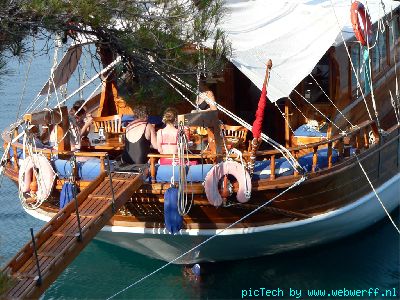
A gulet is a two-masted,
ketch or schooner-rigged steel or wooden yacht with widely varying sail
 plans
and characterized by a wide,rounded stern.
plans
and characterized by a wide,rounded stern.
The word gulet :
(pronounced gulette, from the Italian gouletta)
In Turkish, it does not appear to be widely used until the latter part of the 20th century with the advent of large-scale tourism. The term gulet also began to include other Turkish wooden boats of similar design, two of which are described below.
And what is an Ayna Kiç?

An ayna kiç is similar to a gulet but has a squared off stern. The primary advantage over a gulet is to the passengers in the form of increased cabin space with an aft master cabin(s).
There has been a significant increase in the demand for building ayna kiçs due to tourism and the market for charters. Translated, ayna kiç literally means mirror-assed.
And Tirhandil?
A tirhandil is the centuries-old workhorse of the Mediterranean and is similar to its cousin, the Caique, and the Greek transport vessel called Perama.
The Greek equivalent of tirhandil is Trechenderi.
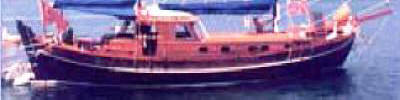
A tirhandil is sailing vessel with origins from the Bodrum area having two masts, a bow spirit and lateen sails. The vessel is beak-nosed with a scoop stern and ample interior capacity."
Caique as being originally Turkish, from kayik, and defines as
a "Levantine sailing vessel" (these were Istanbul caiques, smaller and lighter, when skiffs which used to traverse the Bosphorus as taxi transport for the local
populace.)
Because tirhandils, despite generally being the superior sailing vessel of the three, have less aft deck space for Blue Cruise voyages, they are not as frequently commissioned by local builders and thus remain elusive. Yet it is the tirhandil, more so than the gulet, which carries the most traditional elements of Aegean sailing boats of the last two millennium.